Please FOLLOW ME ON SUBSTACK!


Please FOLLOW ME ON SUBSTACK!

Gorky Is (Probably) The Most Controversial Rock Band You’ve Never Heard Of
Every generation has one: a band too wild, too self-involved, and too chaotic for the mainstream to let in on purpose. For the past 25 years, buried deep in the mountains of rural Arizona, that band has been Gorky, who now have crawled out of the high desert and taken new roots in Portland.
Formed in a high school geography class by Jesse Valencia and his blood brother-in-spirit Ben Holladay, Gorky were destined from day one to be more than just another “indie sleaze” band. Their story reads like a rock’n’roll fever dream: drug-fueled first shows, ex-Hell’s Angels producers, lineups exploding mid-performance, and beefs with Arizona rock royalty. One minute they were getting songwriting lessons from Michelle Branch and opening for bands like Eyes Set To Kill, the next they were nearly sued by Hanna-Barbera over a Flintstones-themed music video and becoming the cover story of The Arizona Republic.
But Gorky is about more than chaos. They are political, prophetic, and deeply of their time. They livestreamed Occupy Wall Street, played Bernie Sanders rallies, and wrote anthems of small-town disillusionment and desert romanticism that helped define the “White Mountain Sound” — Arizona’s answer to Britpop and indie sleaze.
They’ve become a cult legend in the making, a band whose history stands shoulder-to-shoulder with the mythologies of bands much bigger than them, bands like The Velvet Underground, The Libertines, or the Meat Puppets. For 25 years, through tragedy and triumph, Gorky has built a discography that feels less like a career and more like a scrapbook of indie rock’s messy soul.
Now, for Jesse Valencia’s 40th birthday October 6th, his and Gorky’s story comes into focus: not as a footnote, but as one of the great untold epics of American rock’n’roll.
Here is the history of Jesse Valencia & Gorky in 40 Facts for Jesse’s 40th birthday…

What more proof do you need that the Gork is a living relic of the Indie Sleaze era?!
Way back in the MySpace days, there used to be a function where you could look up bands by genre, and you had to list your genre as well so that people could find you and check out your music.
In those days, I was really interested in the idea of making Gorky a band that could play all genres, which is something I think we've achieved. There's Gorky rockabilly, vaporwave, country, metal, R&B, even hip-hop, bluegrass and psychedelia.
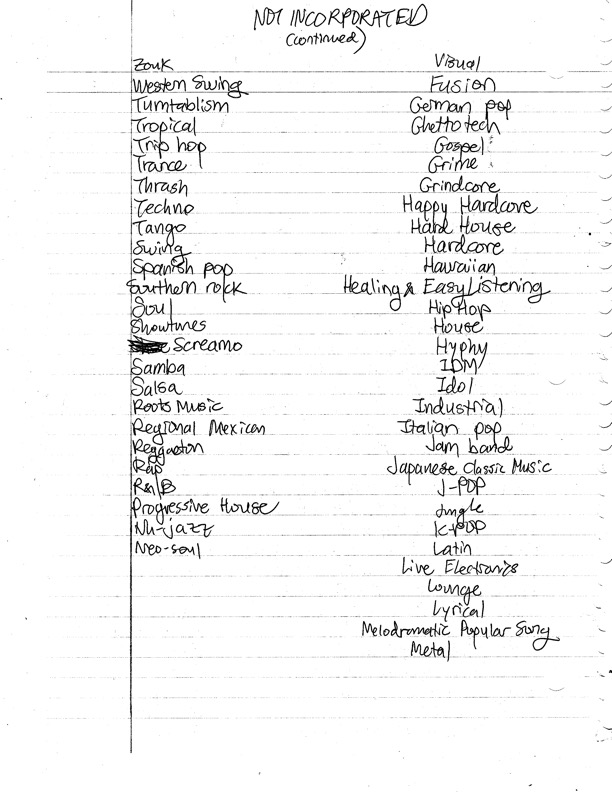
Anyways, while digging through the vaults, I came across these lists I'd written down by hand, where I had gone through every single genre of music MySpace had listed, to see which genres we'd incorporated, and which ones we hadn't yet.
Wouldn't you know it…in doing this little exercise, I've created a historical artifact!
So below are the musical genres we had incorporated and not, as musical genres were understood during the era of Myspace.
What do you notice? How have our understanding of genres changed since then?
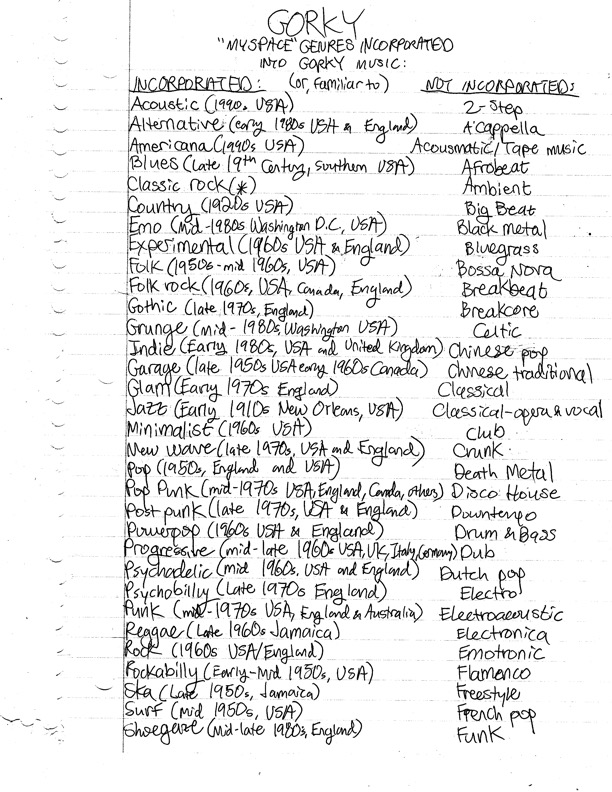
Acoustic (1940s, USA)
Alternative (Early 1980s USA & England)
Americana (1940s, USA)
Blues (Late 19th Century, Southern USA)
Classic Rock (x)
Country (1920s, USA)
Emo (Mid-1980s Washington D.C., USA)
Experimental (1960s USA & England)
Folk (1950s–mid 1960s, USA)
Folk rock (1960s, USA, Canada, England)
Gothic (Late 1970s, England)
Grunge (mid-1980s, Washington, USA)
Indie (Early 1980s, USA and United Kingdom)
Garage (Late 1950s USA/early 1960s Canada)
Glam (Early 1970s, England)
Jazz (Early 1910s New Orleans, USA)
Minimalist (1960s USA)
New Wave (Late 1970s, USA and England)
Pop (1950s, England and USA)
Pop Punk (mid-1970s USA/England/Canada/others)
Post punk (Late 1970s, USA & England)
Powerpop (1960s USA & England)
Progressive (mid-late 1960s USA, UK, Italy, Germany)
Psychedelic (mid 1960s, USA and England)
Psychobilly (Late 1970s, England)
Punk (mid-1970s USA, England & Australia)
Reggae (Late 1960s, Jamaica)
Rock (1960s USA/England)
Rockabilly (Early-mid 1950s, USA)
Ska (Late 1950s, Jamaica)
Surf (mid 1950s, USA)
Shoegaze (Mid-late 1980s, England)
2-Step
A cappella
Acousmatic/Tape music
Afrobeat
Ambient
Big Beat
Black Metal
Bossa Nova
Breakbeat
Breakcore
Celtic
Chinese pop
Chinese traditional
Classical
Classical–opera vocal
Club
Crunk
Death Metal
Disco House
Downtempo
Drum & Bass
Dub
Dutch pop
Electro
Electroacoustic
Electronica
Emotronic
Flamenco
Freestyle
French pop
Funk
Fusion
German pop
Ghetto tech
Gospel
Grime
Grindcore
Happy Hardcore
Hard House
Hardcore
Hawaiian
Healing & Easy Listening
HipHop
House
Hyphy
IDM
Idol
Industrial
Italian pop
Jam band
Japanese classical music
J-Pop
Jungle
K-Pop
Latin
Live Electronics
Lounge
Lyrical
Melodramatic Popular Song
Metal
Neo-soul
Nu-jazz
Pop
Progressive House
R&B
Rap
Reggaeton
Regional Mexican
Roots Music
Salsa
Samba
Screamo
Showtunes
Soul
Southern rock
Spanish pop
Swing
Tango
Techno
Thrash
Trance
Trip hop
Tropical
Turntablism
Western Swing
Zouk
I want to offer my heartfelt congratulations to Meara McLaughlin on her outstanding leadership of MusicPortland and on the City’s declaration of July 10th as Meara McLaughlin Day. It’s a richly deserved honor. Her tireless advocacy has left a lasting legacy on Portland’s music scene, and I’m truly ecstatic to see her recognized for it.
That said, I also want to take a moment to publicly apologize. My recent posts and aggressive tactics in calling out Live Nation and its developer allies—though rooted in documented truths—have cast unintended shadows over friends and allies like Meara McLaughlin, Councilor Dunphy, and the Music Policy Council. I fully understand and accept their condemnation of my actions, and I take complete responsibility for how my anger and satire caused stress and unintended harm to people who never deserved it.
I’m not here to make excuses. But I do want to offer context.
I’m a working-class Indigenous person. My Yaqui family fled genocide in Sonora. So when I saw wealthy developers in Portland—many of them already in positions of power—using language about racial equity to sell themselves public land on behalf of a corporate monopoly, it hit me on a deep ancestral level. Land theft is not an abstract concept to me. I’ve lived it.
To me, this wasn't just shady politics. It was a modern echo of what Porfirio Díaz did to the Yaqui: use public institutions and racial politics to displace marginalized people in the service of corporate interests.
When I learned that this group had quietly been spreading a false narrative to discredit Councilor Dunphy and others who challenged them, I lost it. In a heated moment, I posted a satirical cartoon of two of these individuals—Andrew Colas and Stephen Green—wearing dunce hats, accompanied by a pointed message calling out what I saw as their role in upholding systemic racism under the guise of progress.
It was aggressive. It was crude. And it was meant to be.
But it wasn’t meant to drag others into the fire with me.
When I saw that people I cared about were taking heat for it—people who had nothing to do with it—I took the post down. Not because I regretted standing up to powerful people, but because I had failed to consider how my words would reflect on those around me.
If you’ve seen my work—my music videos, my book, my film, my political art—you know that satire, irony, and offense are part of the toolkit I’ve used for years. But I now see that my usual approach doesn’t always translate when others are caught in the crossfire. And for that, I truly am sorry.
I’ve helped elect good people to office in this city. I’ve done that as myself and on behalf of Gorky—not for any one candidate or organization. But I recognize now that my fire, while effective in exposing corruption, can burn the wrong people too.
So here’s where I stand.
I’m laying down my rhetorical arms. I’m not going to keep targeting individuals in the Portland Metro Chamber, Prosper Portland, or elsewhere. I’ll let the press and public do their jobs holding people accountable.
And I’m going to refocus on the thing that drives me most: my art.
I’m a musician. A writer. A filmmaker. I’m not a politician or policymaker. I’ve done what I can for this city, and I’m proud of that. But now it’s time to finish my film—and to center my energy where it can do the most good.
To everyone who has stood by me: thank you.
To everyone who was hurt or burdened by my actions: I’m sorry.
And to the people still profiting off injustice: the cameras are rolling.
-JMGV
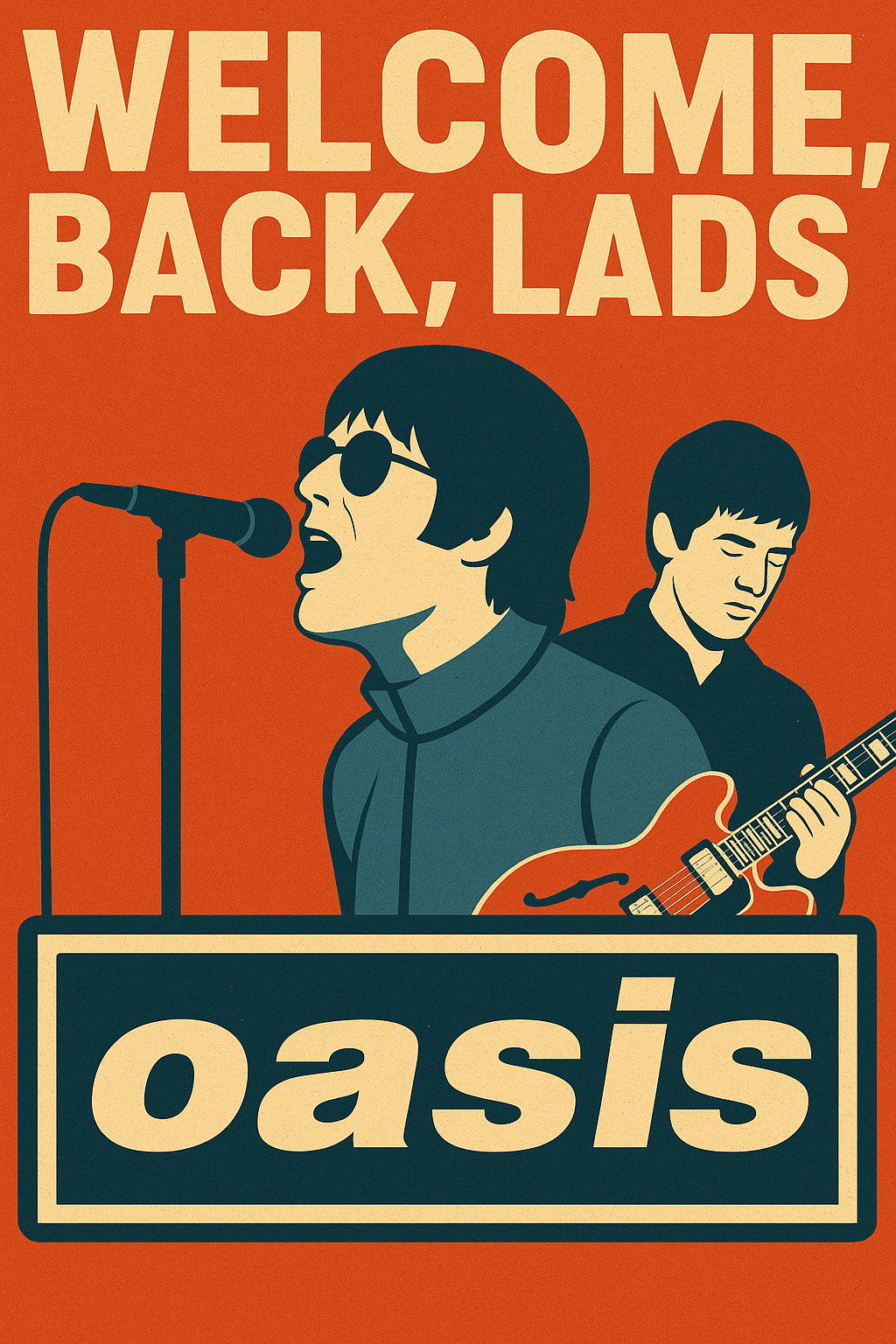
The best thing about the 4th of July was the reunion of the UK’s greatest band.
Man, it brings back some memories.
Foremost among them is I think it's obvious that Oasis’s influence is all over Gorky, for better or worse.
When I joined the Army, I had three CDs which I listened to on repeat: Arctic Monkeys’ Whatever People Say I Am, That’s What I’m Not, Abbey Road by The Beatles, and Be Here Now by Oasis.
I knew very few people at that time who liked the Arctics or Oasis, much less Britpop, but Britpop was everything to me. Not because of an Anglophile thing, though that was certainly part of it, but because it was already a part of my mental fiber growing up.
Back in the 90’s there was this thing called Cool Britannia, and America ate it up. Princess Diana. Spice Girls. Goldeneye 007 on the N64. Austin Powers. And yes, Oasis. I remember seeing Champagne Supernova on MTV and blowing my 10 year old mind out.
My deeper gateway into Oasis, Blur, and the rest of Britpop musically didn’t happen until the later 90s, when The Verve exploded with “Bittersweet Symphony.” I went that direction as a young teen because I couldn’t get into what was big in the US. Sure, we listened to Green Day and Red Hot Chili Peppers and the like, but American rock was just plain goofy compared to Britain, because Britain was cool, and we wanted to be cool. Thank God The Strokes came out when we were sophomores. Otherwise, American rock would have ended up all sounding like Creed or something. And we hated all that stuff.
Playing music like Oasis in a small Southwestern mountain town was a hard sell, and we struggled at first to get shows. Jimmy Eat World was who was popular then, and we couldn’t quite get that crowd. But Ben and I definitely saw ourselves as a kind of Gallagher brothers. The American heirs to Oasis and the American answer to the Arctic Monkeys in one. But most of Arizona didn’t care about the Arctic Monkeys musically in 2005.
2005’s Don’t Believe The Truth is my favorite record of theirs and 100 percent influenced the Gorky sound. So heavy was Oasis in the Gorky orbit that I remember when Oasis broke up, thankfully after I’d seen them, I felt a strong calling to level up my songwriting, to fill the void they’d left. By that time, I was heavy into writing the Brian Jonestown Massacre book, and learning about the recording process.
I think I might have simply stayed in that spot, artistically, because by the time all our biggest songs came out and really started working for us, it was the latter half of the 2010’s, and it’d already been a decade since that kind of rock and roll had been popular. “Action Pants” and “Super Drunk” would have had a lot different impact in 2005 than 2015, when the dawn of Trumpism had all but ruined comedy, parody, and satire itself.
As for the rest of the Gorky catalog, “Be In The Now” and “You’ve Got To Learn To Be Lonely” sound like Oasis songs. There’s Oasis in “Roll With Me,” “Boogie Machine”, “Brave New Animal”—I hear it all over the place. I can hear me and Ben filling that void for ourselves in a lot of these songs. There’s more than Oasis going on. There’s some Strokes, some Libertines, some Weezer, but definitely a lot of Oasis.
Yet now, with Oasis back, suddenly it’s like a standard has returned for guitar music, even though it’s been that long. Especially in the age of AI, someone actually playing the guitar has to mean something.
It seems like now, people need to support local bands and artists more than ever. The point of music isn’t just the sound itself, but the experience required to make that sound, and that song.
Oasis appealed to us because they were working class like us, because their songs are the bollocks, and because they are hilarious.
Welcome back, lads!
-JMGV

Listen to the White Mountain Sound playlist on Spotify.
So what is “the White Mountain Sound”?
It's an undeniably authentically Southwestern sound, rooted in these Colorado Plateau small towns, where country twang, garage rock aesthetics, and songwriting techniques imported from faraway places like the Midwest, NYC and the UK swirled into the minds of a group of millennial high-desert dwelling teens in early 21st century Arizona. Those kids started bands and made their own version of indie rock.
Historically, just because I'm almost 40 now, it started with our band, Gorky, who emerged as the lone surviving band among a group of bands from our high school era of friends, and shortly behind us came Alaska and Me, which I guess if any band could have been called our ‘rival’ band it would have been them. They looked great, their songs were great, and their recordings were great. I remember at the time they were like a more rocking version of Lydia, for folks who remember that band.
Side note: We played with Lydia back in 2004, when they were touring one of their earlier records! Good times.
Anyways, they were and were not our ‘rivals’ because really they were the only other band in town, and they were doing awesome things, and we were all technically friends, because they knew Gregg who played bass with us in those days, and they were the same age, so we all were hanging out. We played two completely different styles of rock music, so there wasn't a real rivalry. They had their audience and we had ours, but there was some healthy competition, I think, at least on our side, because we had never had another band to go up against like that before, and we played a couple shows together but most of the shows were with other bands as we both did our own thing, climbing different ladders.
Zella Day at one point got into their orbit, because I believe she dated the singer Tyler Cox at one time, but I can't remember for sure. I remember I was over at Tyler's once and she was there, and there was a bit of recording going on, whether it was us or them, I can't remember that either. Ha! But anyways that was the only time I remember meeting Zella, and not long after that she went to Los Angeles and started her path there, which for her turned out to be a smart move.
After Alaska and Me split up, Charles Ellsworth left the White Mountains for Salt Lake City and started pursuing his own folk-Americana vibe before he headed out to NYC and the East Coast. The rest of Alaska and Me reformed as Boxen briefly, with a new bass player, Tevin, who would end up being the bass player in Gorky for many years after Gregg left, and from there the other members of Alaska and Me ended up forming their own projects.
Around that time, we really started to take off with our singles and music videos for “Datass” and “Super Drunk”, which was then followed by a fledgling acting career where I got to star opposite Tom Sizemore in Durant's Never Closes and then published my book about the Brian Jonestown Massacre, Keep Music Evil--so in a way that first wave of the White Mountain Sound, of all of us who were friends and played and recorded together, really sprang out and imported our thing to different places. Zella to Los Angeles, Charles to Salt Lake and NYC, and now Gorky to Portland, but before we came to Portland we made Arizona history with the Sitgreaves County stunt.
The main group in the next wave after Gorky, Alaska and Me, and Zella Day is undoubtably Negative 32, who really captured teenage angst with their pop punk sound in ways I think that the first wave of us didn't because we were all too focused on trying to sound like cool adults. Negative 32 has some really good songs.
Sadly, for Negative 32, they did not have a band that was more their age that could compete with them the way we had when we were at their level, but I think that led them to really perfect an original pop punk sound for themselves as well, and I think there is a clear evolution in the songwriting that continues today in their new project, Phantom Spring, which is now based in the Phoenix metro area I believe.
Phil The Band and WRNTY have evolved out of Alaska and Me and Boxen, and I have released a couple of solo Jesse Valencia records as well, though Gorky will return one day. Zella Day has an awesome new indie-retro country group, Chapparelle, that hearkens back to her White Mountain and garage rock roots.
I've also collaborated on some hip-hop tracks with my good friend Brandon Rodelo, a fellow indigenous artist from my cousin tribe Mayo (Yoreme), who has established himself as a leader in the Phoenix hip-hop scene with his song “Arismokazona” featuring the one and only Afroman.
I would say this is really the core of this sound and this playlist, these bands, and how we have interacted with each other and against each other over the years, but to prove that the White Mountains has its own sound I've included tracks from Ryan David Orr's White Mountain-based bands The Brighter Still and The Secret Trails, and Ashley Westcott's own original country tunes. These artists were adjacent to us, and the vibes of the mountain can be heard audibly to benefit us all.
There are strikingly similar themes in our lyrics, in some ways a similar twang, and even in the ways we rock out. I could easily hear all of us playing a show together, even though we're all of different genres.
Also because this has happened in the past, and they are memories to be grateful for.
In the future, I am going to review these records my friends have put out, and really dig into them. Get into what makes them tick, and really celebrate this sound that we created together.
-Jesse

People have always asked me about the name of our band, and wondered if there were political connotations.
There weren't at first, but I leaned into it after a while.
The name of our band comes from my childhood best friend Whitney's name for her comfort blanket, which she called her ‘gorky.’
Neither of us had any fucking clue that ‘Gorky’ was the name of a park in the then freshly-unSoviet Russia, or that it was the name of a Communist Russian author, but once I found out about that stuff, it led me to read Marx and all the great socialists of the olden time, like Che Guevara, who is one of my personal heroes, when I was 16 and 17 years old.
And from there I became something of a Marxist. I even joined the CPUSA, a fact I had to conceal when I joined the Army later, in 2006.
I still would consider myself something of a Marxist, but more philosophically than in a DSA sense. Anyhoos--
Gorky's songs are often about nostalgia, or heartache, or sometimes even about funny, novelty things, but I think most people would not think of us as a political band. Certainly, we're not Rage Against The Machine, but we're not the least political band either.
So I thought--are we a political band? I usually steer away from taking a strict political view because Gorky is a big tent that is welcoming to everyone, and everyone should feel welcome with us, but that being said there are some political positions I have taken in my songs that do amount to what could be described as a left-wing position.
This is interesting to me, because I don't quite fit the leftist/progressive/liberal mold socially or artistically. I mean, look at our songs and our approach to parody and satire. We have been called everything under the sun: sexist, racist, patriarchal, misogynistic, offensive, crude, crass, and so on and so on.
I would say that's because Gorky was born out of a moment in pop culture where the works of Quentin Tarantino, Kevin Smith, Dave Chappelle, and Tenacious D reigned supreme in our teenage minds, and we sort of just stayed there. When we finally started seeing some success in the 2010's, that culture was beginning to be repressed in the youth, and replaced with the unfortunate “woke” culture we see now, so of course songs like “#Datass” and “Super Drunk” were frowned upon, even if they were popular.
This has become difficult to navigate, especially as the stuffy performative social conservatism of my youth has been absorbed into the left more than into the right.
We're in a weird time.
I do know that I am going to stay on the same path I started on a ½ of a century ago, when the band began, because if anything in another 25 years people will look back and Gorky will maybe have accurately diagnosed the first half of the century. Who knows.
I just let the music speak for itself…
“Hey, Donald Trump in office is scary, so if you feel the Bern go vote for Sanders in the primary--”
What is the most bizarre thing about this song is that it was a remix of our 2015 song ‘Super Drunk’ and is just as old as Donald Trump's political career, yet not one word is irrelevant or needs changed. The song is just as relevant today, over a decade later, as it was when we first released it. The cover art features Trump shitting into his own mouth a la ‘tub girl’ for those who know some history of the internet. Anyways, the artist Alex Voss said we could use the art as long as we donated to Bernie, and we did and actually ended up playing Bernie's rally in Flagstaff, Arizona that year, and the song was retweeted by a CNN News Anchor which was cool.
“Keep your head low when you're runnin' from the Border Patrol--”
This song, to the tune of ‘Froggy Went-A Courtin’", tells of my ancestry on my father's mother's side, so the non-Yaqui side of my dad, but after going through this and that ancestor on down the line, I bring it back to current events: the same people who are going after migrants now, like ICE, are the same feds who went after my bootlegging ancestors, my ancestors who were conscripted in mines for labor, and so on and so forth. There's no difference, it's just an authority figure trying to stop people from moving around because it threatens the power structures in place.
“With this new ruler, everyone is to blame--”
With the advent of AI, this pre-AI track from 2019's Mathemagician hits different. The song is really about the over-digitization of society and its effects on mental health, and the song ultimately blames the people for this outcome. If people weren't such flawed moral beings, things like this would never happen, but here we are, in a barely functioning dystopia with an authoritarian leader, and everything that was awful about the future in the movies I grew up watching are now coming true. It's bonkers.
“I'll free Palestine, Tibet and Bangladesh--”
I was saying ‘Free Palestine’ back in 2008 and 2009 when this little rocker came out on The Deuces, while I was still enlisted as an MP in the US Army. I knew back then that these imperialist wars were being fought on Israel's behalf. I have always been against Israeli apartheid and for the liberation of the Palestinian people. As an indigenous person whose family and people were genocided by imperialist powers, I have nothing but sympathy for the people of Palestine and nothing but loathsome disdain for Zionists, which has probably hurt my job prospects over the years.
“LET'S WAR”
“If disinformation got you killing somebody, I think y'all need a shrink--”
Technically this song is on one of my solo records, but it was supposed to be a Gorky record. Anyways, it's all the Gork. But the song is really like a sequel to 'Brave New Animal' in the sense that feeding into these algorithms like we have been doing, these little boxed worlds, has created this awful sentiment between people that ultimately has led to violence. People are getting assassinated and no one cares. School shooting after school shooting, and so on. The way out of this is to get out of our heads and into community.

After months of development, I am ready to announce my new film project, “AMERICAN DREAMS”!
This project has been several years in the making…
It began as my thesis at the David Lynch film school while I was attending there, 2018-2020, and was once called “IN THE LAND OF GOOD OAKS,” as readers of my book “KEEP MUSIC EVIL: THE BRIAN JONESTOWN MASSACRE STORY” will remember.
“Good Oaks” was not without success, as the controversial Sitgreaves County publicity stunt which propelled Gorky to the cover of the Arizona Republic two weekends in a row (and helped flip Arizona blue in 2020) began to attract attention from important industry players.
The script then went through a period of development with some of the creative team behind Purple Rain before I had to split from those guys for their sheer disrespect and unprofessionalism on tangential projects. They say never meet your heroes. I say don’t trust them either.
Then, in January of 2023, my creative partner and Gorky co-founder Ben Holladay died of Alpha-1 Antitrypsin Disease, a rare genetic lung disorder, a week after our dream producer agreed to produce the soundtrack.
“In The Land Of Good Oaks” died with Ben. I tried to get another version of the film going, but it just wasn't working out.
I moved to Portland, Oregon, to be closer to my family and network. In December of 2023, my friend Zia McCabe of the Dandy Warhols invited me to a music policy forum where I met then-city council candidate Jamie Dunphy and joined the incredible organization MusicPortland.
They were fighting Live Nation at the time, and I'd never experienced a music community quite on this scale before. I would be lying if I didn't say my initial reason for joining the fight was to try and pull off another “Sitgreaves,” but as I learned how wonderful and good-hearted Portland's music community was, I laid aside my aspirations and learned to serve without an incentive. This time, I fought for what I felt was the right thing to do.
We fought valiantly, but then the land was stolen. We didn't ‘lose’.
We were bullied into it, and because of the rules of performative political correctness, some were forced to apologize for things they didn't do.
I refuse to acknowledge a ‘loss’ in that fight. To do so is to admit that the opposition defeated us soundly, and I believe they--the Portland Metro Chamber and Prosper Portland, who conspired with Live Nation on the steal--are among the worst civic organizations in the United States.
While falsified accusations of racism led to the land theft in Portland, that isn't where everyone should be focusing. The racism is a smokescreen, a fluke, a distraction to keep Portlanders' eyes averted from the grifting by the city's corporate elite.
Racism is just one part of a larger toolkit that Live Nation, really and truly one of the worst organizations in the world, uses to justify its land grabs.
Avoiding the truth, that the developers manipulated racism, empowered Live Nation to completely dominate the proceedings, and we were bulldozed.
These good people at MusicPortland and the Music Policy Council who I consider friends were the targets of a coordinated attack, and I watched helplessly as they wrestled with the consequences of these falsified accusations. It was like one after another, they felt some manner of guilt or responsibility about it. To me, it was plain as day what was going on around me, and it made me sick to think that a group of people could do this and get away with it so easily.
So I worked as a canvasser for Jamie Dunphy's campaign, knocking on doors and talking to folks throughout Portland about how they'd like to see the city change. At the same time, I lobbied with MusicPortland to engage every candidate we could on music policy and fighting Live Nation.
During this period, Gorky became a policy think tank and lobbying org instead of a band.
In the end, co-organizing with MusicPortland and knocking on doors for Jamie not only got Jamie elected, but it got an entire pro-music city council elected for the first time in the city's history. Our efforts were so successful, that the city's political class were embarrassed to admit that we'd outshined them.
Notably, the Gorky PDX Music Voter Guide was the most accurate voter guide released last year, in terms of endorsed candidates-to-election ratio.
However, unlike my experience in the Arizona Legislature, none of what I did for the City of Portland during this time was bullshit. This experience, which has been an adventure, taught me that community can heal grief, and now that we have a pro-music city council, and the Live Nation fight here is all but over, it is time I take what I have learned, what I've experienced, and do what I actually do.
I am not a policymaker. I am not a politician. I am an artist. And yes, sometimes I use shock. Because it works.
When David died earlier this year, I remembered everything he taught me about being true to my ideas and I realized that the truest idea I have now was to show the people of Portland, the country, and the world the truth of my experience through my art.
It was time to return to the film Ben and I were going to make together, and give it a new birth. A new life.
As David Lynch taught and believed, a disruption of consciousness is sometimes necessary for evolution.
More soon!
The information in this blog post is being absorbed into the PDX LIVE NATION SAGA

PURCHASE “HIGH IN THE LOW” ON BANDCAMP
High In The Low: The Story of Our First Record
Rock and roll mythology isn’t just about the records—it’s about the stories behind them. The chaos, the triumphs, the disasters, the choices that shape an album long before the world ever hears it.
High In The Low is one of those records.
It’s the album that starts with me joining the Army Reserve and ends with me wrecking my car in a DUI. The accident left me with brain damage and a shattered talus, and the sessions for the album were abandoned.
We wouldn’t self-release the record until 2010, by which point we were already deep into recording its follow-up, The Deuces.
Back in 2006, I was stuck in Show Low, Arizona. No money, no clear way out, and a band that felt too small for the dreams we had. The only way forward? The Army Reserve.
I signed up, took the signing bonus, and instead of using it to build savings or plan for the future, I did the only thing that made sense to me—I dropped a small fortune at Guitar Center. It was the kind of spending spree that, in hindsight, felt legendary.
We spent so much money that the store let us draw the Gorky logo on their wall, as if we were some famous band. We weren’t. But in that moment, it felt like we could be.
What did I buy? The biggest speaker I could find. The biggest guitar I could find. At the time, I had no understanding of pedals, tube amps, or the nuances of sound design. I just knew we needed to sound big.
Gorky had always been a scrappy little garage band, but I wanted more—more volume, more power, more presence.
So there we were, playing tiny clubs, lugging around a 4x12 speaker cabinet, absolutely overwhelming the space. It looked ridiculous. But it was a defining moment. That gear lasted for years—two decades later, the drum set and guitar are still in use. That impulsive spending shaped the sound of High In The Low in a way nothing else could have.
The album itself documents that transition—from small-town punks playing dive bars to something bigger, louder, and more unhinged.
A lot of these songs we wrote in high school or shortly after, and our gear just couldn't cut it. We couldn't make it sound like we knew it was supposed to sound, and what it came down to was our equipment. I mean, Ben's drumset was stitched together by leftover pieces from kits that the various school departments had trashed and replaced already, thanks to the kindness of our public school music teachers.
High In The Low feels like a time capsule—a document of a band in transition, searching for identity while absorbing the sounds and culture surrounding us. It captures the energy of youth, the angst of uncertainty, and the thrill of discovery. It was written and recorded in an isolated world, in a town far removed from major music hubs, yet it reaches for something larger, reaching back to rock and roll’s roots while simultaneously looking forward.
Musically, the album grabs from everywhere—there’s garage rock grit, punk urgency, classic rock swagger, and an early attempt at psych-leaning textures (even though we hadn’t yet discovered reverb). The big, overpowering 4x12 speaker cabinet setup resulted in a raw, loud, unfiltered sound, which adds to the charm of the record. We were pushing our technical limits while maintaining a visceral, in-the-moment quality.
The dual influence of Chuck Berry and The Beatles is especially strong, which makes sense given our attempt to go back to the foundations of rock music rather than emulate contemporary scenes.
Songs like "Kick It!" and "Motorcycle" embody that primal rock and roll energy, while "Waiting For Your Love" is a clear nod to McCartney-style melody and arrangement.
The emo-punk undertones show up in "And It Goes On", revealing our attempt to engage with modern sounds but still retaining our own raw songwriting style.
Lyrically, High In The Low is full of longing, frustration, and reflection on youthful experiences.
Many of the songs are about relationships and missed opportunities, likely reflecting our age at the time—just a couple years removed from high school, still processing those emotions.
"No More Time", for example, carries the pain of hesitation, while "Kick It!" is about the innocence of just hanging out rather than hooking up.
There’s also a spiritual and philosophical undercurrent, which has set us apart from many of our garage-punk contemporaries. The Vedic references in "She Spoke" and "When It’s Over" hint at a broader search for meaning, which makes sense considering our upbringing in Show Low—detached from major cultural centers, left to explore deep ideas in our own way.
At the same time, there’s a playfulness in the writing, most notably in "Come On, Sing The Alphabet!", which was my attempt to craft a surrealist, childlike anthem in the vein of The Beatles' "Yellow Submarine." The double meanings and wordplay also add another layer to the album’s themes of youth, experimentation, and the chaos of early adulthood.
The mid-to-late 2000s were an odd time for rock music. The garage rock revival (Strokes, White Stripes, The Hives) was fading, while emo, post-hardcore, and indie rock were taking over. Meanwhile, bands like The Brian Jonestown Massacre and The Dandy Warhols were being rediscovered, making psych rock a future direction for many bands who started in punk and garage.
High In The Low reflects this in-between moment. It’s too raw and punk-driven to fit neatly into indie rock and too rooted in classic rock and roll to be part of the emo/post-hardcore movement.
Being from an isolated scene, we absorbed these influences organically rather than by chasing trends. The result is an album that feels honest, unfiltered, and deeply tied to our own musical and personal journey.
If this album is Level One of Gorky, it serves as an origin story—the blueprint of what was to come.
There’s a hunger in the playing, a recklessness in the storytelling, and a charm in its imperfections.
The fact that it was never meant to be a final product at the time of recording makes its eventual release in 2010 even more significant—it was a delayed but essential piece of our journey.
At the end of it all, High In The Low isn’t just about a band—it’s about a time, a place, and a mindset. It’s about wanting more, taking risks, making mistakes, and figuring it all out along the way.
And in that sense, it remains timeless.
